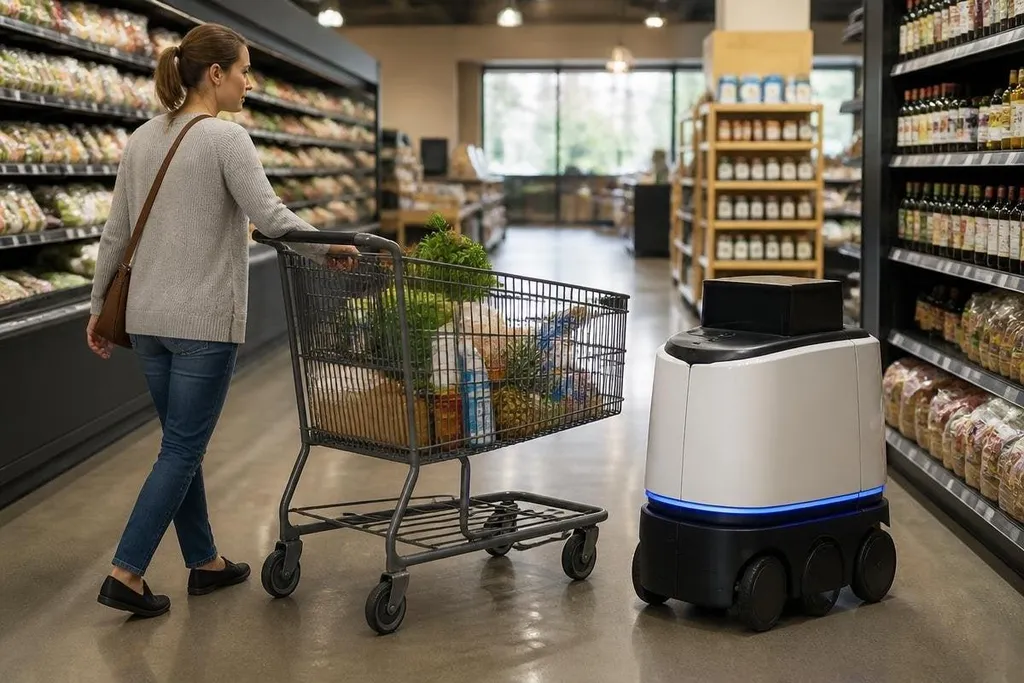
A shopping cart carries products, gives shoppers a place to pause, and costs little to maintain. That machine would need to do all three jobs while moving safely around people, shelves, doors, and checkout lanes.
For now, the stronger case is a robot that works beside the cart, not one that removes it.
- Cart strength: cheap, familiar, and available at every store entrance
- Robot strength: can move by itself and carry stock or customer bags
- Main gap: safe movement around people still needs careful control
What a robot cart would need to do
A robot cart would need a drive system, a battery, sensors, and software that keeps it on the right path. Cameras and LiDAR could help it detect people, shelves, and other carts. Wheel encoders could track how far it has moved, while mapping software could help it find its way around the store.
That hardware solves only part of the job. The robot would also need to stop when a child steps in front of it, slow down near a crowded aisle, and remain stable when a shopper adds a heavy item. A cart can sit still without making a decision. A robot has to make one every time it moves.
Shopping loads change during each trip, so the robot would need to handle uneven weight without tipping or losing control. A low centre of gravity helps, but it also makes the drive system work harder when the robot turns or crosses a threshold.
The store has to support it
A robot cart works best in a store built around its limits. Wide aisles, clear floors, reliable charging points, and doors that open without human help would make deployment easier. Older stores may have narrow turns, ramps, floor gaps, and displays that move from week to week.
The robot also needs a clear handoff at checkout. It could follow a shopper, stop at a collection point, or carry bags after payment. Each option changes how staff work and where the robot waits. A machine that blocks an aisle during a busy period creates a new problem for the store.
The safety rules matter just as much. A store would need a physical stop button, speed limits, fault alerts, and a way for staff to move the robot by hand. Remote control may help when the robot gets stuck, but a remote operator cannot remove every risk from a crowded shop.
A store's first test is practical: can the robot move through aisles without blocking shoppers or needing staff at every turn? Robot24.com's shopping robotics coverage can name the store, route, trial length, and staff workload before the next section looks at where these machines may fit first.
Where robots may fit first
The first useful systems may handle jobs that shoppers already find awkward. One could carry a large order from the checkout area to a vehicle, bring stock from a back room, or follow a worker during shelf restocking.
Those tasks have clearer routes and fewer decisions than guiding a customer through every aisle.
A store could also offer a robot cart to shoppers who need help carrying goods. The cart would remain a transport tool, while the shopper still chooses products and controls the visit. That arrangement keeps the familiar basket and adds assistance where it has a clear use.
The price and upkeep would decide the business case. A store would have to pay for batteries, sensors, software updates, cleaning, repairs, and staff training. A standard cart needs collection and maintenance too, but its design has had years to become cheap and easy to manage.
A practical buying check
Before a store tests a robot cart, its operations team should check these points:
- Map the route: mark narrow aisles, ramps, doors, checkout lanes, and places where queues form.
- Set the load: define the basket weight, centre of mass, and speed limit for a full load.
- Test the stops: place people and loose objects in the route, then measure stopping distance at each speed.
- Plan recovery: give staff a safe way to lift, tow, or manually move a disabled robot.
- Count the labour: include charging, cleaning, software checks, customer help, and repairs in the cost.
- Choose one task: start with a route that has a clear result and a small number of failure points.
The opposing view has merit: a robot cart could help shoppers with limited strength or reduce the work of carrying heavy goods. But a normal cart already handles the basic job with few moving parts and little training.
I'd keep shopping carts as the default and use robots for carrying, delivery, and stock work until stores can show safe operation, low upkeep, and a clear cost per shopping trip.